Part 1
Questions 1-13 The Origins Of Cinema
The Origins Of Cinema
A Many consider that the history of motion pictures began in 1824, when the British doctor Peter Mark Roget described an optical effect he called persistence of vision -- the illusion of movement created when a series of still pictures are set into motion. Over the next decades, this idea inspired a number of simple optical toys and mechanical inventions related to motion and vision. One of the most significant was created in 1834 by the British inventor William George Horner. Originally called a Daedalum, but better known by its later name of Zoetrope, Horner’s device consisted of a hollow drum, rotated by means of a crank. Around the drum’s inner surface was a strip of paper with a sequence of paintings, drawings, or illustrations on it. As the device turned, the viewer could observe the illusion of moving images through regularly spaced narrow slits.
B The development of still photography in the mid-19th century led to the creation of a number of variations on the Zoetrope. In 1861, the US inventor Coleman Sellers patented the Kinematoscope, a device containing a sequence of stereoscopic (3D) photos on glass plates, in a rotating box. 1870 saw the first public demonstrations of US inventor Henry Renno Heyl’s Phasmatrope, one of the earliest devices to show apparently ‘moving’ photographs. On February 5th of that year, Heyl delighted audiences at the Academy of Music in Philadelphia with his photographs of dancers, shown in rapid succession so as to create the impression of motion.
C The next step in the history of motion pictures was the invention of the Praxinoscope. Devised in 1877 by Frenchman Charles Emile Reynaud, this refined version of the Zoetrope had mirrors at the centre of the drum. This was followed in 1879 by the British photographer Eadweard Muybridge’s invention of the Zoopraxiscope. Also known as ‘the wheel of life’, this machine recreated the illusion of movement. Images appeared on a screen, having been projected from a series of photos printed on a disc that turned when the machine was operating.
D However, true motion pictures, rather than eye-fooling ‘animations’, could only occur after the development of a flexible film capable of recording split-second pictures. In 1882, French innovator and physiologist Etienne-Jules Marey, often regarded as the ‘inventor of cinema’, constructed a camera (or ‘photographic gun’) that could take 12 photographs per second. Marey’s chronophotographs, as he called them, were revolutionary, and he was soon able to achieve a rate of 30 images per second. Further experimentation was conducted by French-born Louis Aimé Augustin Le Prince, who used long rolls of paper covered with photographic emulsion for a camera that he devised and patented. A few seconds of his 1888 motion picture film entitled Traffic Crossing Leeds Bridge still survive.
E In November 1890, William Dickson, the young British assistant of the famed US inventor Thomas Edison, devised a simple but ingenious motor-powered motion-picture camera known as the Kinetograph. This used 35mm-wide film made out of celluloid, a newly developed synthetic gelatin-coated material which was transparent, strong, and flexible. Officially launched in 1892, Dickson’s camera featured an innovative system of sprockets (teeth on a moving wheel) that connected with sprocket holes in the celluloid, and advanced the film. The sprocket system would momentarily pause the film before the camera’s shutter to create a photographic frame (a still or photographic image). Although its bulky motor was soon to be replaced with a lightweight hand-crank mechanism, the Kinetograph set the standard for the motion picture cameras that would be used for the next century.
F Dickson also designed an early version of a movie-picture projector called the Kinetoscope. Around that same time, he filmed his first experimental Kinetoscope trial film, Monkeyshines No. 1, the only surviving film from the cylinder Kinetoscope, and apparently the first motion picture ever produced on photographic film in the United States. It features the movement of laboratory assistant Sacco Albanese, filmed with a system using tiny images that rotate around the cylinder.
G Meanwhile in Lyons, France, brothers Louis and Auguste Lumière, often called ‘the founding fathers of modern film’, were inspired by Edison and Dickson’s work. They created their own portable, hand-held device, known as the Cinematographe, patented in February 1895. This multi-purpose device, which combined camera, printer, and projecting capabilities, was more profitable than Edison and Dickson’s model, because a number of spectators could watch the film on a large screen at the same time. On December 28, 1895, the Lumières presented the first commercial exhibition of a projected motion picture to a paying public in the world’s first movie theatre in the Salon Indien, at the Grand Café on the Boulevard des Capucines in Paris. Cinema, a word derived from Cinematographe, had finally arrived.
Questions 1--4
Label the diagram below.
Choose ONE WORD ONLY from the passage for each answer.
Diagram of the Zoetrope
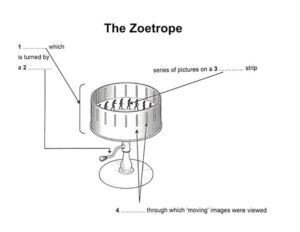
1. 1
2. 2
3. 3
4. 4
Questions 5--8
Complete the table below.
Choose ONE WORD ONLY from the passage for each answer.
| Year | Invention | Description |
|---|---|---|
| 1861 | Kinematoscope | displayed 3D images on 5 |
| 1870 | Phasmatrope | showed an audience images that appeared 6 |
| 1877 | Praxinoscope | an improved version of the 7 |
| 1879 | Zoopraxiscope | projected pictures from a 8 |
| 1890 | Kinetograph | a motion-picture camera moving a film through its sprocket system |
Questions 9--13
Do the following statements agree with the information given in Reading Passage 1?
In boxes 9--13 on your answer sheet, write
TRUE if the statement agrees with the information
FALSE if the statement contradicts the information
NOT GIVEN if there is no information on this
9. The advantage of Etienne-Jules Marey’s invention was the speed with which it could record images.
10. William Dickson’s system of powering a movie camera with a motor was used for a great many years.
11. Several movies made for the cylinder Kinetoscope are still in existence today.
12. The Lumière brothers’ invention was used to make and show movies.
13. None of the audience at the Salon Indien in December 1895 had ever seen a motion picture before.
Part 2
Questions 14-27 Brains trust: learning about ourselves
Brains trust: learning about ourselves
A Why are we thinking so much about thinking these days? Books discussing how the brain works sit near the top of best-seller lists around the world and unlike most self-help books, these take a realistic view of life as we know it, and put forward the idea that change can only occur with a lot of hard work. These books possess the unifying theme that the choices we make in day-to-day life are prompted by impulses lodged deep within the nervous system. Not only are we not masters of our fate but we are captives of biological determinism. Once we start to consider the strange neuronal world known as the brain, we discover that -- to put the matter plainly -- we have no idea what we’re doing.
B Professor Daniel Kahneman, who has won the Nobel Prize in Economic Science, has synthesized a lifetime’s research in neurobiology, economics and psychology. Thinking, Fast and Slow goes to the heart of the matter of how aware we are of the invisible forces of brain chemistry, social cues and temperament that determine how we think and act. Kahneman breaks down the way we process information into two modes of thinking: System 1 is intuitive, System 2 is logical. System 1 operates automatically and quickly, with little or no effort and no sense of voluntary control. For example, we react to faces that we perceive as angry faster than to happy faces because they contain a greater possibility of danger. System 2 allocates attention to the effortful mental activities that demand it, including complex computations. It makes decisions and normalizes irrational data either by organizing it to fit a made-up narrative or by disregarding it altogether.
C Another book, The Power of Habit, is more proactive. New York Times journalist Charles Duhigg’s thesis is that we can’t change our habits, we can only acquire new ones. Addicts can’t stop their bad habits through willpower alone; instead they need to alter behavior. He believes that people can accomplish amazing things in life by turning round a losing team by teaching them not to think. By teaching ball players an immediate response to situations encountered on the field, he removed the need for decision making.
D Interestingly, many of these writers are preoccupied with the how instead of the why of things. It used to be that the main explanation focused on emotional or social distortions of thought. What these writers are doing instead is looking at brain research, using the tools of our modern age -- neurobiology, brain scans, retinal research -- to prove that reflection plays a less important role in our lives than we ever realized.
E The 18th-century philosopher David Hume didn’t have these modern tools at his disposal, but he framed the question in much the same way. His major work, A Treatise of Human Nature, explored the ways in which habit rules our lives. Hume’s experiments with perception, for example how we respond to colors, distance or numerical sets, prefigure the rigorous science of Professor Kahneman. The intention of both was to show the natural weakness and the lack of stability in both our imagination and our senses. Consciousness, like philosophy itself, stands on a weak foundation.
F If Hume seems modern, American psychologist and philosopher William James reads like a contemporary. Writing toward the end of the 19th century, James addressed the same question that had concerned Hume about how the unconscious operates as a physical process, not just a mental one. In his now-classic and often cited essay, Habit, he argued that even our most complex acts are reflexive. People perform many acts unthinkingly -- they act before they think. But what about people who involuntarily perform acts that are against their own interests, like biting their nails? The answer is that we can train ourselves to change if we work at it hard enough. Understanding why we act the way we do can free us from our bad habits. ‘The great thing, then, in all education,’ writes James, ‘is to make our nervous system our ally instead of our enemy.’
G Does all of this mean that we have no capacity to act on our own, or can autonomy thrive without us even knowing? ‘We have to believe it does,’ says Steven Lukes, a professor of sociology at New York University. ‘If we seriously thought that our intentions made no difference to how we behave, we couldn’t go on using the language of ethics. How would we go on living the lives we live?’ So do these books actually help us do what we think is right? We may feel as if we’ve learned something from discussions such as these but that feeling could well be an illusion itself.
Questions 14--19
Reading Passage 2 has seven paragraphs, A--G.
Which paragraph contains the following information?
Write the correct letter, A--G, in boxes 14--19 on your answer sheet.
| A | B | C | D | E | F | G | |
|---|---|---|---|---|---|---|---|
| 14. a challenge to the relevance of all the books mentioned in the article | |||||||
| 15. an account of changed behaviour reversing failure | |||||||
| 16. examples of scientific and technological advances that are used to study how the brain functions | |||||||
| 17. evidence of how popular the topic of brain research is | |||||||
| 18. a description of the different ways the brain functions | |||||||
| 19. a mention of an old text to which many other writers continue to make reference |
Questions 20--23
Match each statement with the correct writer, A--D.
NB You may use any letter more than once.
List of Writers
A. Daniel Kahneman
B. Charles Duhigg
C. William James
D. Steven Lukes
20. People are unable to alter their routine behaviour but they can add different types of behaviour.
20
21. Quick responses occur if someone feels unsafe.
21
22. Self-awareness is central to making positive changes.
22
23. The brain has the ability to ignore illogical information.
23
Questions 24--26
Complete the summary below.
Choose ONE WORD ONLY from the passage for each answer.
Early research into the brain
David Hume’s A Treatise of Human Nature examined how people are controlled by 24. The book studies people’s reactions to various stimuli such as colours, in its investigation of 25. His studies were carried out without the 26 employed in scientific research today by researchers such as Professor Kahneman. Hume aimed to demonstrate that our senses and our creative thought are unreliable and based on an innate weakness.
Question 27
Choose the correct letter, A, B, C or D.
27. In the final paragraph, Steven Lukes makes the point that
Part 3
Questions 28-40 Facial Expression
Facial Expression
A A facial expression is one or more motions or positions of the muscles in the skin. These movements convey the emotional state of the individual to observers. Facial expressions are a form of nonverbal communication. They are a primary means of conveying social information among humans, but also occur in most other mammals and some other animal species. Facial expressions and their significance in the perceiver can, to some extent, vary between cultures with evidence from descriptions in the works of Charles Darwin.
B Humans can adopt a facial expression to read as a voluntary action. However, because expressions are closely tied to emotion, they are more often involuntary. It can be nearly impossible to avoid expressions for certain emotions, even when it would be strongly desirable to do so; a person who is trying to avoid insulting an individual he or she finds highly unattractive might, nevertheless, show a brief expression of disgust before being able to reassume a neutral expression. Microexpressions are one example of this phenomenon. The close link between emotion and expression can also work in the other direction; it has been observed that voluntarily assuming an expression can actually cause the associated emotion.
C Some expressions can be accurately interpreted even between members of different species -- anger and extreme contentment being the primary examples. Others, however, are difficult to interpret even in familiar individuals. For instance, disgust and fear can be tough to tell apart. Because faces have only a limited range of movement, expressions rely upon fairly minuscule differences in the proportion and relative position of facial features, and reading them requires considerable sensitivity to the same. Some faces are often falsely read as expressing some emotion, even when they are neutral, because their proportions naturally resemble those another face would temporarily assume when emoting.
D Also, a person’s eyes reveal much about how they are feeling, or what they are thinking. Blink rate can reveal how nervous or at ease a person may be. Research by Boston College professor Joe Tecce suggests that stress levels are revealed by blink rates. He supports his data with statistics on the relation between the blink rates of presidential candidates and their success in their races. Tecce claims that the faster blinker in the presidential debates has lost every election since 1980. Though Tecce’s data is interesting, it is important to recognize that non-verbal communication is multi-channelled, and focusing on only one aspect is reckless. Nervousness can also be measured by examining each candidates’ perspiration, eye contact and stiffness.
E As Charles Darwin noted in his book The Expression of the Emotions in Man and Animals: the young and the old of widely different races, both with man and animals, express the same state of mind by the same movements. Still, up to the mid-20th century, most anthropologists believed that facial expressions were entirely learned and could, therefore, differ among cultures. Studies conducted in the 1960s by Paul Ekman eventually supported Darwin’s belief to a large degree.
F Ekman’s work on facial expressions had its starting point in the work of psychologist Silvan Tomkins. Ekman showed that contrary to the belief of some anthropologists including Margaret Mead, facial expressions of emotion are not culturally determined, but universal across human cultures. The South Fore people of New Guinea were chosen as subjects for one such survey. The study consisted of 189 adults and 130 children from among a very isolated population, as well as twenty-three members of the culture who lived a less isolated lifestyle as a control group. Participants were told a story that described one particular emotion; they were then shown three pictures (two for children) of facial expressions and asked to match the picture which expressed the story’s emotion.
G While the isolated South Fore people could identify emotions with the same accuracy as the non-isolated control group, problems associated with the study include the fact that both fear and surprise were constantly misidentified. The study concluded that certain facial expressions correspond to particular emotions and can not be covered, regardless of cultural background, and regardless of whether or not the culture has been isolated or exposed to the mainstream.
H Expressions Ekman found to be universally included those indicating anger, disgust, fear, joy, sadness, and surprise (note that none of these emotions has a definitive social component, such as shame, pride, or schadenfreude). Findings on contempt (which is social) are less clear, though there is at least some preliminary evidence that this emotion and its expression are universally recognized. This may suggest that the facial expressions are largely related to the mind and each part on the face can express specific emotion.
Questions 28--32
Complete the summary below.
Write NO MORE THAN TWO WORDS for each answer.
The result of Ekman’s study demonstrates that fear and surprise are persistently 28 and made a conclusion that some facial expressions have something to do with certain 29 which is impossible to cover, despite 30 and whether the culture has been 31 or 32 to the mainstream.
Questions 33--38
Reading Passage 3 has eight paragraphs, A--H.
Which paragraph contains the following information?
NB You may use any letter more than once.
| A | B | C | D | E | F | G | H | |
|---|---|---|---|---|---|---|---|---|
| 33. the difficulty identifying the actual meaning of facial expressions | ||||||||
| 34. the importance of culture on facial expressions is initially described | ||||||||
| 35. collected data for the research on the relation between blink and the success in elections | ||||||||
| 36. the features on the sociality of several facial expressions | ||||||||
| 37. an indicator to reflect one’s extent of nervousness | ||||||||
| 38. the relation between emotion and facial expressions |
Questions 39 and 40
Choose TWO letters, A--E.
Which TWO of the following statements are true according to Ekman’s theory?