Questions 1-10
Complete the notes below.
Write ONE WORD AND/OR A NUMBER for each answer.
TOTAL HEALTH CLINIC
PATIENT DETAILS
Personal information
Example
Name: Julie Anne Garcia
Contact phone: 1
Date of birth: 2, 1992
Occupation: works as a 3
Insurance company: 4 Life Insurance
Details of the problem
Type of problem: pain in her left 5
When it began: 6 ago
Action already taken: has taken painkillers and applied ice
Other information
Sports played: belongs to a 7 club
goes 8 regularly
Medical history: injured her 9 last year
no allergies
no regular medication apart from 10
Questions 11-15
Choose the correct letter, A, B or C.
Visit to Branley Castle
11. Before Queen Elizabeth I visited the castle in 1576,
12. In 1982, the castle was sold to
13. In some of the rooms, visitors can
14. In the castle park, visitors can
15. At the end of the visit, the group will have
Questions 16-20
Label the plan below.
Write the correct letter, A-H, next to questions 16-20.
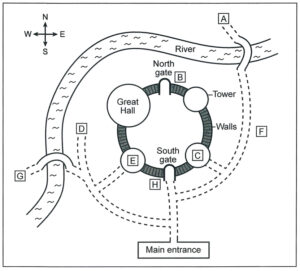
16. Starting point for walking the walls 16
17. Bow and arrow display 17
18. Hunting birds display 18
19. Traditional dancing 19
20. Shop 20
Questions 21-24
Choose the correct letter, A, B or C.
Woolly Mammoths on St Paul’s Island
21. How will Rosie and Martin introduce their presentation?
22. What was surprising about the mammoth tooth found by Russell Graham?
23. The students will use an animated diagram to demonstrate how the mammoths
24. According to Martin, what is unusual about the date of the mammoths’ extinction on the island?
Questions 25-30
What action will the students take for each of the following sections of their presentation?
Choose SIX answers from the box and write the correct letter, A-H, next to questions 25-30.
Actions
A. make it more interactive
B. reduce visual input
C. add personal opinions
D. contact one of the researchers
E. make detailed notes
F. find information online
G. check timing
H. organise the content more clearly
25. Introduction 25
26. Discovery of the mammoth tooth 26
27. Initial questions asked by the researchers 27
28. Further research carried out on the island 28
29. Findings and possible explanations 29
30. Relevance to the present day 30
Questions 31-40
Complete the notes below.
Write ONE WORD ONLY for each answer.
The History of Weather Forecasting
Ancient cultures
Many cultures believed that floods and other disasters were involved in the creation of the world.
Many cultures invented 31 and other ceremonies to make the weather gods friendly.
People needed to observe and interpret the sky to ensure their 32.
Around 650 BC, Babylonians started forecasting, using weather phenomena such as 33.
By 300 BC, the Chinese had a calendar made up of a number of 34 connected with the weather.
Ancient Greeks
A more scientific approach.
Aristotle tried to explain the formation of various weather phenomena.
Aristotle also described haloes and 35.
Middle Ages
Aristotle’s work considered accurate.
Many proverbs, e.g. about the significance of the colour of the 36, passed on accurate information.
15th-19th centuries
15th century: scientists recognised value of 37 for the first time.
Galileo invented the 38.
Pascal showed relationship between atmospheric pressure and altitude.
From the 17th century, scientists could measure atmospheric pressure and temperature.
18th century: Franklin identified the movement of 39.
19th century: data from different locations could be sent to the same place by 40.