Questions 1-10
Complete the form below.
Write NO MORE THAN TWO WORDS AND/OR A NUMBER for each answer.
INTERNATIONAL STUDENT TRAVEL AGENCY ENQUIRY FORM
| Name: | Sarah Brown |
| Date of birth: | 1 |
| Address: | 21 Waverley Road, Radstone, RD4 6WV |
| Contact tel. no.: | 2 |
Notes
- wants to travel in 3 Europe
- hopes to travel by 4
- interested in working in a 5
- recommended to consider an alternative, e.g. 6 work
- advised to buy a European 7 for travelling
- given a 8 with accommodation details
- agreed to take out 9 from the Agency
- told to use an 10 for contacting people
Questions 11-15
Label the map below.
Choose the correct letter, A-H, next to Questions 11-15.
BIBLIOSTACK -- GROUND FLOOR
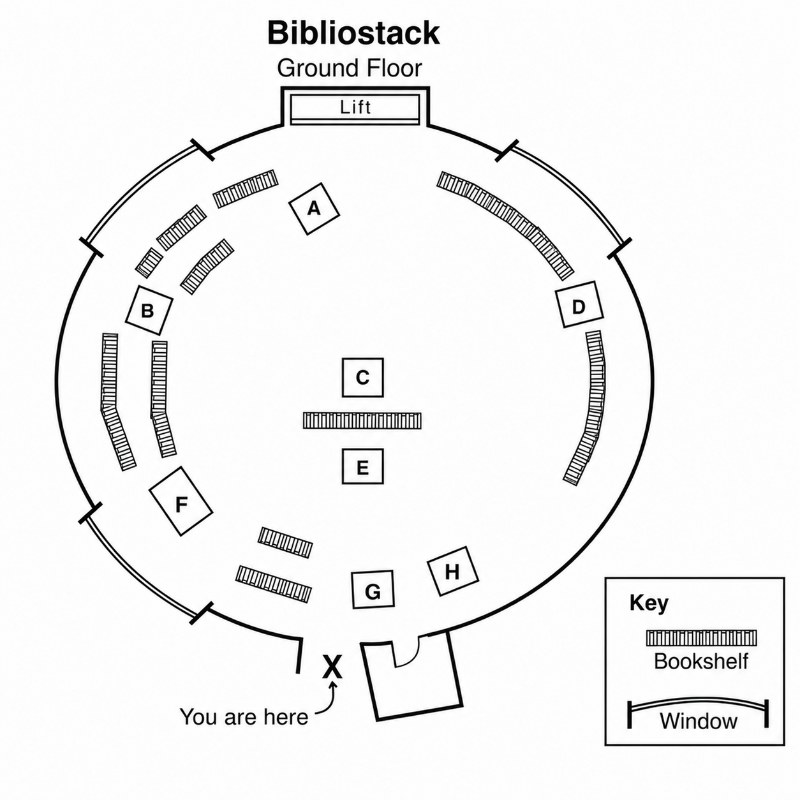
11. Seating area 11
12. Cushions 12
13. Computer bench 13
14. Café bar 14
15. Newspapers 15
Questions 16-20
Choose the correct answer.
16. The bookshop aims to
17. Children’s books are located on the
18. To help parents relax, the bookshop
19. Regular book readings are organised to
20. At the poetry workshop, participants
Questions 21-24
Choose the correct answer.
THE JUST-IN-TIME SUPPLY SYSTEM (JIT)
21. Ron suggests that in his presentation he should have
22. The tutor says that in his presentation Ron omitted
23. Ron says that he found his information on standardising parts from
24. The tutor suggests that in the service sector, JIT is
Questions 25-30
What criticism is made of each of the following technical aspects of Ron’s presentation?
Choose SIX correct answers, A-H, next to Questions 25-30.
Criticisms
A. too informal
B. too irregular
C. too predictable
D. too sudden
E. too technical
F. too unenthusiastic
G. too loosely related
H. too vague
25. Speed of delivery 25
26. Purpose 26
27. Transitions 27
28. Visuals 28
29. Vocabulary 29
30. Body language 30
Questions 31-40
Complete the notes below.
Write ONE WORD ONLY for each answer.
DYSCALCULIA
- Teaching applied in class: 31 method of teaching
- Children have difficulty learning the concept of 32 and sequence.
- In the class, they are taught through everyday practical examples, e.g. dealing with 33.
- Children with mathematics disorders should practise more calculations to develop more 34.
- Teachers encourage them to solve problems by making educated 35.
- They do exercises, e.g. breathing, relaxation and 36 breaks.
- Researchers would like to find a potential 37 with language learning difficulties.
- Children are likely to have problems with 38 and focus.
- With this approach, children no longer need 39 training.
- Dyscalculia affects children and also their families and 40.